Hybrid events require more versatility and more rigorous organization than other formats. With an extra digital technical layer (live streaming of the event) as well as an extra interaction layer for the audience attending virtually, this type of event is fairly complex.
A good hybrid event aims to create a three-way exchange: your speakers need to interact with your in-person audience, but also with your online audience.
So we'll try to walk you through the technology behind hybrid events:
🦾Understanding the technology behind a hybrid event
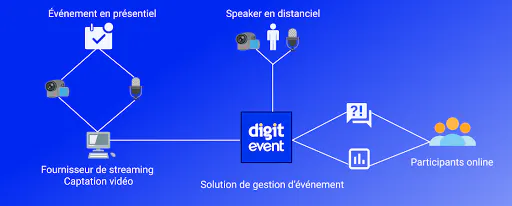
Here's a simplified diagram of the different information flows in a hybrid event managed by Digitevent.
How the video and audio signal is transmitted
Overall, while your event is taking place, an on-site production team records and broadcasts what's happening in person at the same time. To do this, a cameraman and a sound engineer film and record a video signal and an audio signal.
These two signals are sent to an encoder (often a desktop computer or a fairly powerful laptop) that compiles this data to output a video stream (with sound added). The provider responsible for this service is called the streaming provider. Their role is to output a clean video stream and send it to the internet (using the on-site connection if it's sufficient, or their own internet connection).
Once this signal is sent, it reaches the streaming platform (YouTube Live, Twitch, or directly on Digitevent). The platform can then broadcast the stream live, while collecting guest messages through live interaction modules. These solutions (whether Digitevent or another) have servers large enough to host and broadcast the video live to thousands of participants at the same time.
Issues that can arise once the signal is sent
This is often where the difficulty lies in the process.
This is especially true if you have one or more remote speakers. Even with the best possible connection and computers, a speaker's internet connection can still fail, in which case there's nothing you can do to improve the quality of the image (from their webcam) or the sound.
And even though this incident is beyond your direct control, participants always blame the whole event if the slightest hiccup mars the experience.
To prevent these external risks, test each speaker's equipment and make sure there's no point of friction. Always have a backup plan and different scenarios ready so you can easily “anticipate the unpredictable”.
We hope these tips help you better understand the technology and the different stakeholders that make a hybrid event run smoothly! :)