Long before Covid, virtual was an original format full of promise. The Covid crisis only underscored the need to add a virtual layer to events.
So here's our feedback from experience, plus the best practices (and pitfalls to avoid) we give our clients, after successfully supporting dozens of digital events.
Three factors will guarantee the success of your virtual event: energy, entertainment, and interaction.
This article was written thanks to the expert advice of Félix, the head of Customer Success at Digitevent.
Habits to adopt for your virtual events:
Here are 5 best practices we identified in last year's projects, which will help ensure you don't get virtual events wrong:
1 - Take inspiration from those who do it best: television
If you think about it, TV and radio companies have become, after decades of refining the format, experts in entertainment and information. Able to hold your attention for hours in front of a screen, they teach us some important best practices:
First, create short programs: TV programs run between 20 minutes and 1.5 hours for the longest ones. The average is 45 minutes. That's also the kind of length you should aim for when covering a topic, which can be a "segment" within a longer program. The key point, as with TV, is to avoid dragging things out.
It's easy to forget, but an attendee who wants to leave your event can do so very easily (in one click) and won't come back. Keep in mind that staying in front of a screen is exhausting and demands more attention than being there in person.
2 - Build energy, right before the event
Building energy even before the event starts is crucial to ensuring a good kickoff. We mentioned earlier that the start of your digital event matters a lot for setting the tone and making your guests want to stay for the whole thing.
So if your company is running a digital event with a built-in chat module (which we strongly recommend), having attendees greet each other and start chatting before the event begins can only work in your favor.

This has two benefits:
- Viewers become active participants. They're no longer alone in front of their screens.
- It helps "unlock" the shyest guests, who become more willing to introduce themselves, chat, and ask questions during the rest of the event, without necessarily having to appear on video.
For this to work, you need a few first messages to be exchanged. Sometimes attendees find it hard to make the first move. Try reaching out to your regular event guests (often the most engaged). Plan for the risk, small but real, that no one wants to speak up first, and encourage your own colleagues to give things a push by introducing themselves in the chat.
3 - Create entertainment
Entertainment helps attendees feel like active participants in your event, and enjoy taking part in it.
Several entertainment tips for your digital events:
First, don't hesitate to play background music a few minutes before your corporate event starts. This lets attendees adjust their volume and hear that the event is about to begin.
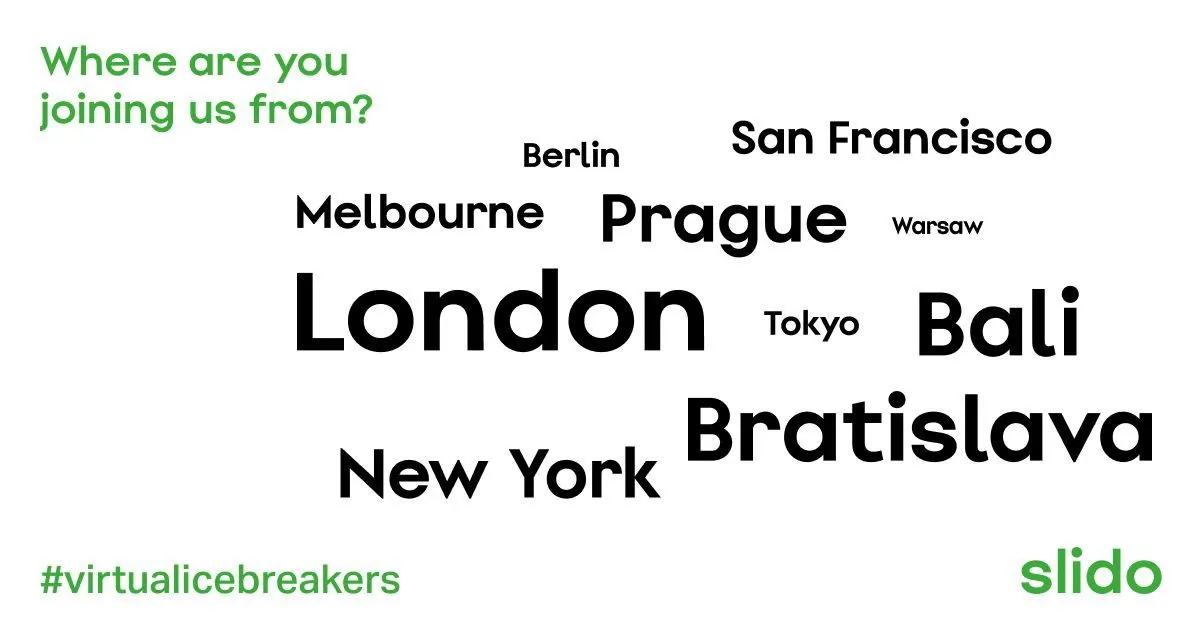
Along the same lines, use an ice-breaker, like a word-cloud poll that everyone will want to join in on. A great example:
Another important point: take breaks! No one will listen to your professional event straight through without any breaks. If nothing else, give your speakers time to catch their breath. Like on TV, add breaks between segments (TV commercials are a good example of this).
During breaks, display a screen showing the remaining break time, like on this website.
If during your video call you want to randomly pick someone to speak on a topic or share their point of view, you can use the wheel of names.
4 - Create interaction
Try to re-engage your audience with a quiz, a poll, or anything else that asks for a bit of thought or action, roughly every 10 to 15 minutes. A person's attention span in front of a screen is about 3 minutes, but if they take an active action, that attention span can of course be extended. Either way, attendees are more likely to follow what you're saying after taking part in the discussion.
Another tip for livening up your professional events, straight from human nature: nobody likes coming in last. Tap into that competitive spirit and create quizzes, using tools built directly in or external tools (like Kahoot or Mural).
Attendees are always driven by the desire to get the right answers. Allow enough response time for each question so you don't frustrate your audience.
You'll see, everyone eventually gets caught up in the game. It creates a kind of back-and-forth between your speakers and the audience's various answers, often with laughter, and a relaxed, enjoyable atmosphere for all your guests.
5 - Master preparation and run your program with total peace of mind
Preparation is a crucial step in any event. So is strategy.
If one of your speakers is in a room with an echo during the event, the sound quality will suffer. Check the actual recording conditions carefully (echo, for example, isn't audible over the phone), make sure there's no feedback, and rule out any other technical issues.
Ask your speakers not to switch microphones at the last minute, not to plug in headphones (which could trigger an automatic mic switch), and to stick as closely as possible to what was rehearsed.
Getting set up well in advance also greatly reduces the risks. We recommend being ready and operational an hour before the event's start time. For phygital or hybrid events, this helps put the speakers, the production team, and the whole recording studio at ease.
Hardware and software issues (equipment or browsers used) can also stop your attendees from properly following your event. Don't hesitate to set up technical support by phone or chat, so your guests are never left stranded.
If several of your speakers are located and filmed in the same place, get help from a provider specialized in video production to achieve a professional result. Video filming and directing is a job in its own right. Virtual is a relatively new format, so it's normal to hit a few snags at first.
Finally, always favor quality over length, and avoid keeping habits that will work against you.
Speaking of habits that will work against you:
Habits to drop for your next virtual events
On the contrary, some habits from "traditional" events should be banned when it comes to digital formats.
Here are a few examples:
1 - Trying to turn an in-person event into a webinar
8:30 > 9:00 = Coffee and networking
9:00 > 10:00 = Speaker introductions and presentation
10:00 > 10:30 = Q&A session
This kind of schedule, fairly common in person, should be completely avoided for virtual events, especially webinars. The reason is simple: it gives no energy, no impact to the start of your digital event, you don't get straight to the point. So there's a good chance attendees will quickly leave your digital event if it follows this kind of schedule.
In the in-person events we used to know, the hardest step was getting attendees to show up on site. It's the exact opposite for virtual events and webinars: the hardest part is keeping your audience there for the whole event. Provide value, useful tips, insights drawn from real cases you've actually encountered, and advice specific to their industries.
So you'll need to rethink the goal of your events: a virtual event needs much more relevant content than an in-person one to "make up for" that lack of contact. You'll need to address your audience warmly and give them as much value and visibility as possible into upcoming industry trends. Keep in mind too that the better the online communication around the event, the better your turnout and retention will be throughout the event.
In short: rethink your experience with your medium in mind (the medium is how your audience receives information). Be your guest's guide for the whole length of your webinar, virtual conference, or whatever the format. Be a professional who brings an expert point of view to the topic at hand.

2 - Assuming turnout will be lower because of the virtual format
You should approach the virtual event as a challenge to embrace, with enthusiasm. Even as something new.
You have a unique chance to be creative and bring a lot of value to your prospects, seize it!
If you don't believe in it yourself, you'll carry out every preparation task out of necessity rather than desire. In a kind of vicious circle, this will end up limiting your creativity and your ability to create an event experience that stands out.
Show why your digital event will be appealing, and what immediate benefits your guests will get from it. Prove that you'll deliver value by showcasing your speakers and applying best practices to increase your attendance rate. In short, use a bit of communication and marketing know-how to get your guests to attend your online event.
Conclusion
The most successful events are designed with the goal of offering less, but better, without falling into the pitfalls mentioned earlier.
Virtual or hybrid events are complex formats to get right, requiring a different kind of rigor and more complex technical specifics than an in-person event. Since you don't fully master the subject at first, it will take more effort the first few times (like riding a bike for the first time).
No worries, you'll get better over time.
We hope this non-exhaustive list has helped you get a clearer picture for organizing your next virtual and hybrid events.
PS: If you'd like to learn more about digital events, we've created a 17-page ebook on the topic :)