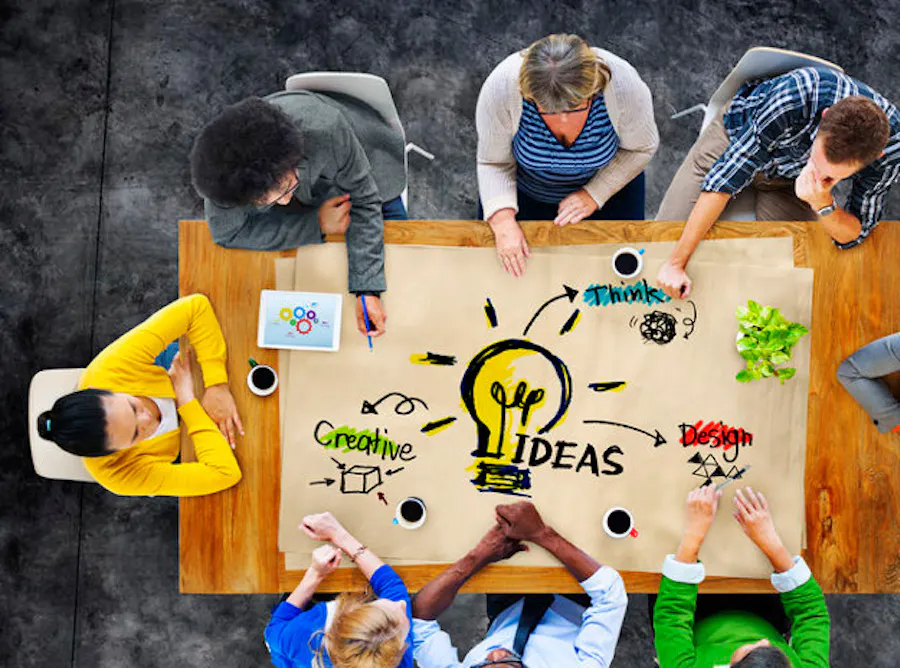
"Alone we go faster, together we go further!" : this phrase perfectly captures the major challenge collective intelligence represents for event design. With respect for stakeholders and in a caring, attentive spirit, collective intelligence brings out innovative, high-quality ideas.
1. Inspire - collaborate - have fun
In these pandemic times, it's sometimes hard to see the bright side and stay creative. Thinking together about a shared project and setting yourselves constraints are a good way to find original, impactful ideas. We all have something to learn from each other. Let's remember (if we've forgotten), that our jobs are above all based on relationships and exchange.
The whole point is to succeed, through various methods, in combining the strength of teamwork with individual qualities. What matters is that each person feels listened to and heard, and that exchange and interaction within the group help improve each individual idea to get the best out of it. Involving stakeholders helps strengthen participant engagement and prevent tension. So let's not hesitate: let's get inspired, collaborate, and have fun!
Collective intelligence also helps gather quality content to build your event's storytelling. Keep in mind that it's essential for it to tell a story or have a coherent thread, in order to engage and impact participants before, during, and after the event.
Before communicating your storytelling, you can use a series of powerful hooks to prepare your audience to receive your message, such as analogy, figures, a scoop, or sharing a piece of personal information that reaches out to your audience and builds a connection.
2. Methodologies
👉 Brainstorming & brainwriting
To kick off a good ideation process using collective intelligence, it's best to start with an individual phase of brainstorming.
A variant on brainstorming: brainwriting. You write your idea on a sticky note (physical or virtual) and pass it to your neighbor, who then builds on the idea to improve it.
To go even further, don't hesitate to give your group constraints (budget, industry, etc.) so it comes up with distinctive ideas and steps outside its comfort zone.
👉 Open forum
The open forum (or world café) also relies on input from others to improve the quality of ideas. Over an afternoon on a specific topic, for example, the group can take on a problem to solve, generate quality ideas, sort them, prioritize them, and propose an action plan. The group can only get behind the proposed actions since everyone took part in shaping them. It's a good way to teach every stakeholder to work as a group, with each person's personality and ideas.
👉 Design thinking
Last method: design thinking. It helps develop innovative products and services by placing the user at the heart of the thinking and giving structure to the project's progress. Here are the 3 main steps:
1. Immersion : interview users and try to understand everyone's expectations
2. Ideation : draw inspiration from everything around you (videos, photos, etc.) and put out every idea that comes to mind (same principle as brainstorming).
3. Prototyping and testing : keep the best ideas and move into project mode. To do this, use shadowing, a technique that involves having participants test the project to check that it works well and meets expectations. Always remember to take the context of use into account. At each step, check that the initial problem hasn't changed.
3. Run a collaborative workshop: find a solution to a problem together
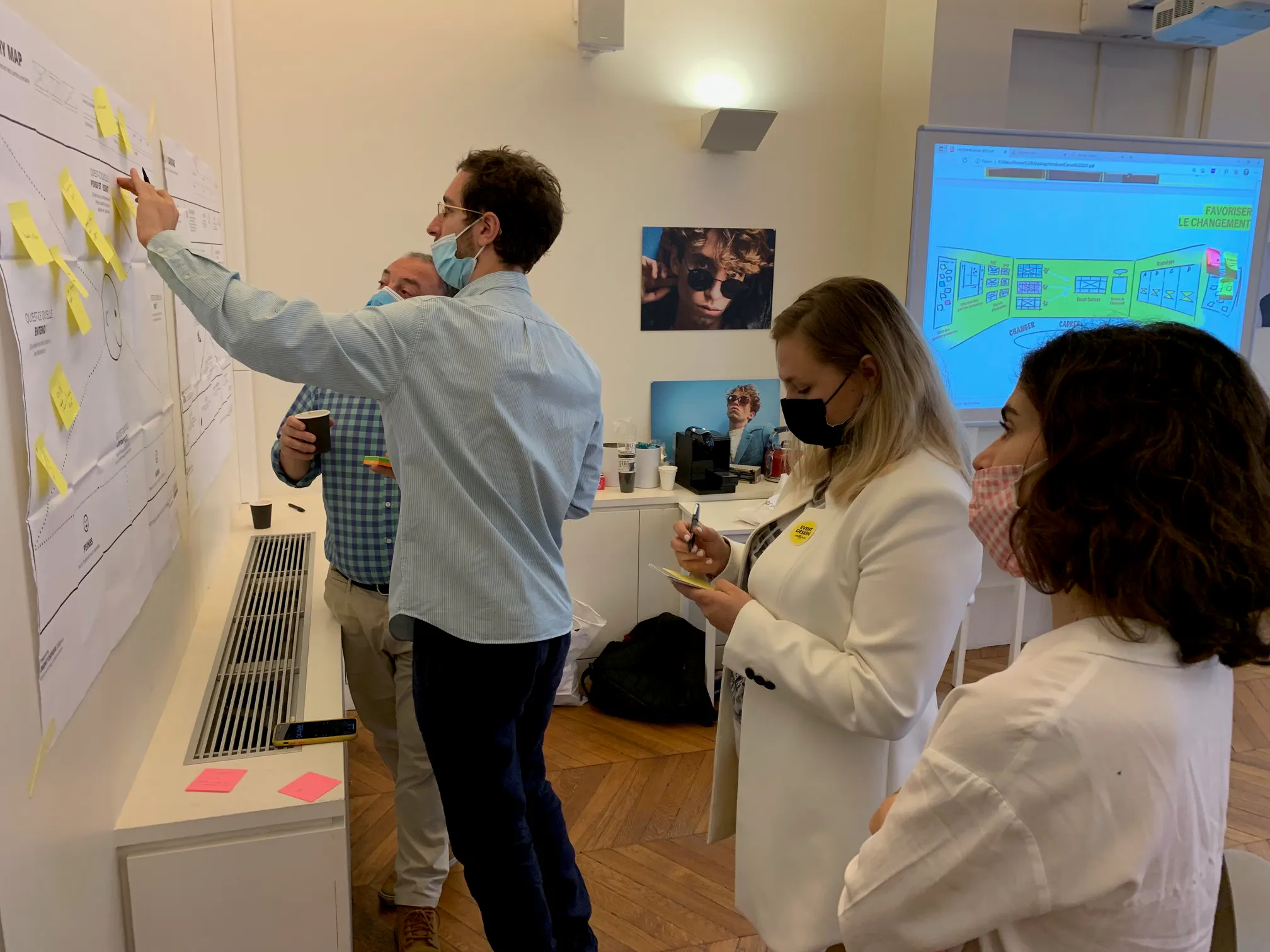
Running a collaborative workshop will help you identify the key elements of a clear, useful, and accurate action plan, and make sure you haven't forgotten anything. To do this, it's important to position yourself as a mediator, giving you the benefit of the participants' hands-on experience, while checking the project's feasibility and boosting your creativity through collective intelligence.
Here are a few steps:
👉 Consolidate the information : individually, get familiar with the context and try to understand the source of the problem. Before defining and implementing solutions, make sure you've completed the previous steps and share a summary with participants.
👉 Identify the challenges : the problem(s) will help you define an action plan. The wording should be SMART: specific, measurable, ambitious, realistic, and time-bound.
Also individually, for each problem you can then:
● Analyze the conditions, the pros and cons.
● Check what has already been tried internally or in similar organizations.
● Think about a specific goal you'd like to achieve. ● What resources can you draw on, and what constraints do you need to manage?
● Prepare the necessary documents (maps, legal texts, etc.)
👉 Prepare the workshop content:
A. Invitations & communications: choose the scope of participants you've selected: strangers, close contacts, colleagues, external stakeholders, and inform them of the location, date, and theme of your workshop.
B. Methodologies : get help from an external facilitator who explains the rules and agenda and helps you run the workshop, and make sure you maintain a creative, constructive atmosphere throughout the workshop
👥 A few tips for creating a creative atmosphere:
● Ideas should fit in a few words
● Participants build on each other's ideas but don't comment on or judge them
● Everyone writes and shares their ideas one at a time.
C. Prepare the workspace : arrive early so you're calm and relaxed when others arrive. For the setup, make sure you have a large table with chairs for everyone. A circle layout works best.
D. Introduction : give your group a 10-minute presentation detailing your vision, the day's purpose and objectives, the context, the stakeholders, and the solutions you've already considered.
👉 Run the workshop and facilitate discussion:
A. Discussion phase : unlock participants' creativity so they bring new ideas based on their own experience and viewpoints, and prepare a few questions to move the discussion forward. This phase should be dynamic and respectful of everyone. Feel free to jot down a few ideas on a board.
B. Splitting into small groups : divide the group into subgroups and check in with them to make sure everything is going well.
C. Presenting each group's ideas: one person from each group presents the results of their work for 5 minutes in front of the audience
D. Discussion phase : take the floor to sum up the main ideas and try to propose several solutions that could address the original problem
✍️ Materials needed:
● Sticky notes/eco-friendly sticky notes
● Pens/pencils
● Cardboard, whiteboard, or chalkboard
E. Ending : thank participants before they leave, and collect their email to thank them afterward for their contribution, presenting them with the solutions produced (favor visuals), and share photos/videos of the workshop.
📢 To make full use of everything collective intelligence has to offer, discover EventCanvas, a methodology specific to Design Thinking for events. Vincent Roux, a digitalization expert, can train you in the EventCanvas 1 & 2 courses.
📩 Contact: contact@vincentrouxconsulting.fr / 06.26.03.38.32