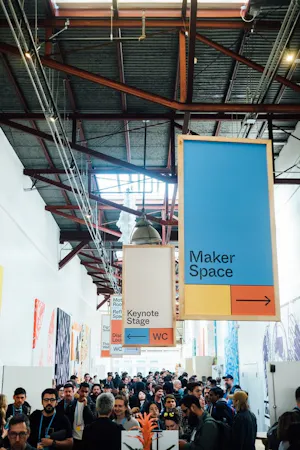
B2B trade shows and forums, congresses, and conferences are among the events whose success is hard to evaluate, both because of the number of attendees (virtual as well as in-person) and because of the number of exchanges and interactions during the event, which is a difficult figure to measure.
Trade show organizers' clients have a dual objective: on one hand, to gauge new developments in the market (gathering information), and on the other, to close new deals with partner companies and prospects while boosting their brand's visibility.
The outcome objective for organizers of B2B trade shows and meetings is therefore multiple:
- Generate revenue
- Create networking between the different attendees, so they find added value and come back every year (customer loyalty)
- Ensure the trade show's visibility
- Satisfy stakeholders (exhibitors, partners, attendees)
It's of course important to think about your event's overall strategy, from marketing to logistics, including communication and its content.
Generate revenue
For all sales-related line items (which we'll detail below), you should carry out an analysis of revenue and margin.
To do this, we suggest several examples of general metrics, then KPIs by line item, more specific to the relevant results for that item:
General KPIs for the revenue-generating line items of a B2B trade show:
- Growth rate compared to previous editions:
(Revenue generated by booth sales (line item #1) in year N / Revenue generated by this same line item in N-1) x100 - Share of the line item in total revenue generated:
(Revenue of the line item / Total trade show revenue) x100
- Revenue achieved compared to initial targets: to compare revenue against a target, you first need to define that target :)
(Revenue of the line item / Forecast target of the line item) x100
You'll obviously need to prepare an Excel file (or even better, a shared Drive!) to track these KPIs ahead of the event, so you can be "data driven" and make sure you can produce an effective, objective assessment afterward.
1. Generate revenue through exhibitor booth sales
To measure the effectiveness of this objective as a trade show organizing company, you can use one of the following indicators:
- Completion rate:
(Number of booths sold / Total number of booths for sale) x100. Calculate both in volume and in value. - Exhibitor renewal rate:
(Number of new exhibitors / Total number of exhibitors at the trade show) x100
Don't hesitate to "upsell" your booths to generate extra revenue: offer a carpet installation option, premium wifi, coffee machines, or a hosting and hostess service. The higher the quality and performance of what you offer, the more easily your upsells will sell.
You can draw inspiration from yield management techniques and pricing techniques used in the hotel industry (or airlines). Many articles on yield management have been written and can inspire you on these optimization topics: here's one that sums up the idea well.
2. Generate revenue through sponsorship
The goal is to have the event sponsored by one or more sponsors and to highlight the visibility gain it brings the sponsor's brand (in short, an exchange of visibility / digital marketing for payment).
With this in mind, you need to create an effective sponsor package and find the right sponsor whose marketing department will genuinely benefit from a win-win partnership to reach its prospects.
Don't hesitate to reach out to your sponsors to better understand their motivations (visibility, leads, performance, content promotion, promotion of a specific offer, etc.) and their target audience. Just as you would with regular clients.
Find sponsors on sites like Sponsor My Event and create sponsor packages tied to these objectives and target audiences.
Sponsorship isn't necessarily limited to an exchange of visibility for payment. Don't hesitate to be creative in how you structure your partnerships (for example, a simple LinkedIn post can bring you visibility!).
Note that the more sponsors there are, the less visibility each one gets! So be careful not to "oversaturate" your event.
Set a maximum number of sponsors (based on your number of attendees) so as not to devalue your sponsorship.
Once that's done, several key elements can be measured to make sure sponsorship is working well and that your partners will be satisfied with the business you're bringing them:
- Exposure rate per sponsor:
(Audience exposed to the sponsor's visibility / Total audience) x100 - Sponsor quota:
(Number of sponsors / Maximum number of sponsors) x100 - Revenue quota:
(Current sponsorship revenue / Maximum sponsorship revenue) x100 - Sponsor renewal rate:
(Sponsors present this year who were also sponsors in N-1 / Total sponsors) x100
Finally, just as with booths, you can also use upsell strategies in your sponsorship: offer paid access to a VIP lounge, a short sponsored video at the start of your event, an ad banner in the trade show's communications (emails, magazine, brochures, etc.) The possibilities are (almost) limitless!
3. Generate revenue through catering services
The prime example is catering at an in-person trade show: you can offer an additional catering service.
Here too, you can set up a partnership, for example by bringing in a Michelin-starred chef: their reputation will grow, and your attendees will be eager to try the service.
Here, the KPI for the caterer's success is fairly simple to measure: count the number of empty plates! :)
4. Generate revenue through sub-events, within the event
You can also organize a private evening on the sidelines of the main event. A perfect opportunity to filter attendees and create a light atmosphere that's ideal for informal connections between attendees.
Monetize this event by sending invitations reserved for your most prominent attendees, or those whose main goal is to network with the key figures at your event.
To manage complex registrations and check-in, such as access to a VIP lounge, Digitevent has designed a specific solution for organizers of trade shows, forums, and professional gatherings.
To measure the success of these sub-events:
(Number of VIP lounge spots sold / Maximum number of spots) x100
It's important to really take care of this additional experience, in all its aspects: bar, music, and warm atmosphere, discussion spaces and meeting spaces.
5. Use a lead-collection app for exhibitors
You can sell your attendees access to the badge-scanning app. With a simple QR code scan on an attendee's badge, it automatically records their data so you can retrieve it afterward.
Measure the success of this application simply by observing whether exhibitors scan each other's QR codes, or by measuring the sales success of this feature.
6. Organize an award and a prize ceremony
Prize ceremonies are an excellent way to generate revenue: attendees at your trade show can compete against one another for various awards (and the pride of displaying that award on their websites / social media, which also promotes your trade show at the same time).
What's more, depending on the scale of your trade show, the awards associated with it will become increasingly recognized. There's a good chance your exhibitors will be ready to pay to compete.
These award ceremonies can generate interesting content for your client companies: you could also consider selling them replay content from the award ceremonies.
You can also monetize certain exclusives, such as the option to distribute goodies during the event.
Create networking among attendees
Since the goal is to create as many exchanges and as much networking as possible among attendees, certain key indicators will make the difference between the success and failure of your event (especially in B2B).
- Meeting rate per attendee:
(Number of meetings obtained / Number of attendees)
This rate matters, because the higher it is, the more useful and easy to use your meeting-scheduling feature has been, and the more value it will have given your attendees.
Conversely, the lower this rate, the more disappointing the experience is for your attendees, and the more likely they are to come away frustrated.
With Digitevent, you can calculate this average number of connections created at a virtual event just as easily as at an in-person event.
- Meeting request acceptance rate:
(Number of meetings accepted / Number of meetings proposed) x100
- No-show rate:
(Number of no-shows / Number of registrants) x100
Don't forget that you can monetize all these meeting and matchmaking features with your exhibitors or sponsors, as we saw earlier with the idea of creating multiple sponsor packages.
Indeed, our networking tool lets you generate virtual rooms for each meeting, while a smart attendee directory lets your guests schedule meetings with other attendees. Finally, our Live Event interface lets you filter activity types and highlight the event's different sponsors.
After the event, send out a satisfaction survey on the perceived quality of the meetings you offered during your trade show or conference.
Ensure the trade show's visibility
Of course, the more reputable a trade show or conference is, the less effort you'll need to put into finding exhibitors, who will rush to book the best booth as soon as the participation form opens.
To build your event's visibility, we recommend working with a communications agency that will grow your brand awareness among your target audiences.
To measure your visibility goals, we recommend setting realistic targets beforehand, such as: X% of my attendees must follow me on social media.
Then, after the event, you can compare your figures against the targets set beforehand and draw the necessary conclusions (insufficient visibility, too little value delivered? Or on the contrary, forecasts exceeded, excellent customer satisfaction?).
Tools like mention.com will help you measure the number of mentions of your website, and in particular the press coverage of your B2B trade show or conference.
Overall satisfaction with the experience
After the event, it's key to gather feedback from all stakeholders to stay in a process of continuous improvement, at every edition of your trade show.
For your post-event satisfaction forms, we recommend using the well-known Likert statistical scales, which will give you a sharper picture of your attendees' overall satisfaction.
When writing your questionnaire, don't forget to address each group: your exhibitors, your sponsors, your attendees. You'll therefore need to write three different satisfaction questionnaires!
If you want to do this properly, don't hesitate to make around fifteen calls with various attendees, sponsors, and exhibitors to get live feedback on the trade show over the phone.
Your exhibitors are the heart of your B2B trade show. Since they are both your main source of revenue and the ones who bring all the content and new developments to your trade show, you must satisfy them at all costs for your trade show (or conference) to be a success.
To do this, as we mentioned, give them a precise idea of who will be attending your event (number, demographics, seniority level, etc.) so they have as much visibility as possible.
To measure the satisfaction of your trade show's exhibitors, we suggest a simple indicator: the retention rate. This indicator is based on the principle that if an exhibitor wants to work with you again next year, it's because they were satisfied.
- Exhibitor renewal rate:
(Number of current exhibitors who were also there in N-1 / Total number of exhibitors) x100
Conclusion
If you're a B2B conference or trade show organizer, you could build a dashboard that includes all of these KPIs so you have real-time tracking of how the different aspects of your event are progressing. Digitevent's real-time dashboard can be a solid foundation for measuring relevant information, for natively data-driven events.
This way, you'll have maximum visibility and be able to accurately anticipate whether you're ahead of or behind your targets.
Looking to organize a B2B trade show or conference in the coming months? Talk to a Digitevent project manager, who'll be happy to walk you through the technical possibilities for your project.