Artificial intelligence has been on everyone's lips for several years now, and for good reason: this technology promises to create a real disruption in many professional fields.
This is the case for events, only the disruption isn't necessarily where you'd expect. Rather than a technological revolution in itself, AI applied to events mainly calls for redefining human and creative roles.
Here, we'll look at why artificial intelligence changes what happens behind the scenes of an event, but not its soul.
How AI is reshaping event industry jobs
Automating repetitive and logistical tasks
First, artificial intelligence can be used as an interesting event management tool.
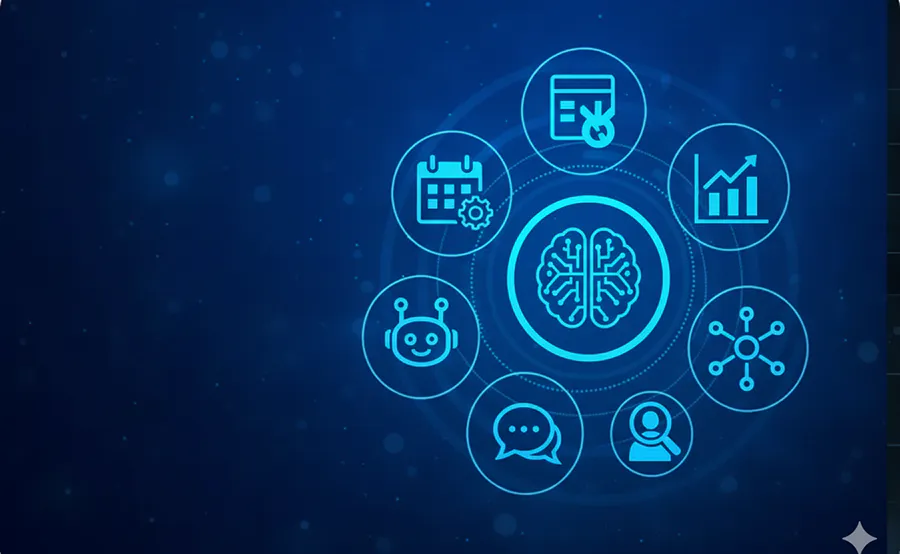
Used well, it handles time-consuming tasks, such as registrations, sending invitations, follow-ups, attendee tracking, data management, and reporting.
The result: a real gain in time and efficiency on planning, resource allocation and logistics, all of which become more streamlined. Organizers now have more time to devote to impactful, valuable activities, rather than repetitive logistical tasks.
Data analysis, personalization and informed decision-making
Moreover, AI has a data analysis capacity far superior to that of a human brain.
It can automatically analyze data in real time, such as the history of previous events, attendee behavior, or their feedback, to make predictions. This way, organizers can anticipate peak attendance times on-site, guest preferences and relevant topics to consider, as well as the resources to deploy.
This data-driven dimension improves the ability to design events that are well-suited, coherent, and calibrated for the target audience. That helps make your event marketing more targeted, with segmented invitations and personalized communications.
Toward new roles and skills: orchestrator, strategist, experience curator
Integrating AI into events means changing not only the processes but also the role of the traditional organizer. They spend less time on manual management, and therefore, more time on experience design, storytelling, and overall event strategy. This is why we can talk about a "transformation of professions".
Moreover, new profiles are emerging in the sector: people who can combine creative abilities, strategic vision, and mastery of AI tools. These include "augmented event managers", "prompt strategists", or even "augmented experience designers". These professionals are aware of both AI's benefits and its challenges (particularly in terms of data security or event standardization, as we'll discuss later in this article).
The challenge for those using AI in events: orchestrating artificial intelligence, meaning deciding what should be automated, what should remain human, and what makes sense.
In practice, orchestrating AI means making decisions on four fronts:
- What gets automated: repetitive, time-consuming tasks (registrations, follow-ups, logistics), to free up time
- What stays human: high-value decisions (storytelling, relationships with speakers, strategic trade-offs), where AI doesn't add real value
- What makes sense: aligning the tools you choose with the event's goals, to avoid technology for technology's sake
- What stays under control: human oversight of AI-generated results, to guarantee consistency and quality
But be careful: the mistake would be to think these use cases are enough to create a memorable event. Sure, they create efficient events. But the difference between efficiency and impact remains deeply human.
The danger of standardization: when AI creates generic events
If the promise of AI is to personalize events by helping event creators save time, in practice, that's not always the case. Find out why.
The limits of AI alone: a homogenization of content and formats
First, it's crucial to understand that many generative AI tools rely on “best practice” or “template” logic. The result: automated visuals, standard wording, and predictable event scenarios.
As a result, AI can sometimes lead to events “produced” quickly but interchangeable, lacking singularity and a memorable mark.
The pitfall of the “machine-like” experience: smoothness ≠ emotion
Second pitfall to keep in mind: sure, artificial intelligence can plan the agenda, send notifications, optimize workflows, but it creates no emotion, no connection, no surprise.
So if you use AI only as a pure automation tool, you risk building one-off events, soulless, without a distinctive mark. Hence the need to combine human and machine.
From excessive automation to the dilution of strategic value
In short, automating everything that can be automated amounts to creating low-cost events, run quickly. And that's the opposite of what brands are often looking for, namely: impact, engagement, meaning.
For a company, an event isn't just a logistical moment: it's a strategic tool, a brand-image lever, a positioning marker. For an organizer like you (or an event platform, like Digitevent), the value of AI isn't just technological: it's about forcing us into deep reflection, to put humans and strategy back at the center.
The event as a human competitive advantage: AI serving value, not the other way around
Industry experts who successfully combine AI and events are clear: technology doesn't replace humans, it only enhances them. Here's how.
Artificial intelligence as a lever for the human experience (not as a substitute)
It's a fact: AI optimizes logistics, personalization, the back office. But it doesn't replace creativity, intuition, emotion. For premium events, it's these human qualities (storytelling, staging, experience design, and creating interactions) that make the difference.
In-person presence, emotion, connection: what AI will never be able to automate
Today more than ever, the value of an event often lies in authenticity, encounters, cohesion, shared emotion, dimensions exclusive to humans. Using AI doesn't create connection: it supports it.
In the age of LLMs, the event becomes more than ever a brand experience, a marker of difference, a rare and living moment.
Strategy and storytelling: the new playing fields of differentiation
Our advice for combining AI and events? Bet on consistency, meaning, intention, conceptual personalization, rather than large-scale production. Your goal becomes creating “memorable moments”, unique, thought through, adding the human touch that artificial intelligence doesn't have.
Best practices to follow to combine AI and events sensibly
Discover how to use AI in events brilliantly, to create differentiating experiences.
Use AI to free up time, not to minimize the human factor
First, make sure to precisely define the use cases for AI in creating your events. The real question here is: what should be automated, and what should be left to humans?
Our advice:
- Automate low-value tasks to focus on design, experience, strategy.
- Reserve key decisions (like scenarios, the attendee journey, storytelling, or interactivity) for humans.
Keep “human oversight”: data and AI, but with critical judgment
Second crucial best practice: make sure of the quality of the data you feed to AI. Alongside this comes a second one: making sure your human interpretation of AI results is accurate.
Indeed, AI can give you insights, but it's up to humans to decide what to do with them. Hence the need to test, adjust, and measure real outcomes, without blindly trusting technological promises.
💬 "Artificial intelligence doesn't make events smarter by default. On the contrary: without human thinking, it risks standardizing them. It removes the superfluous in event professions, but makes the essential even more demanding. It thus reveals organizers' level of maturity, and their ability to produce intention, vision, and high-level creativity. Our conviction at Digitevent is simple: find the right level of automation for execution so you can focus on what really creates value, the experience, the emotion, and the human relationship." - Joy Grand, Marketing Manager
Ensuring ethics, respect for the experience, and transparency
Using artificial intelligence in events requires a clear framework. Transparency, data protection, and ethics aren't secondary topics, but essential conditions for a successful experience. Informing attendees about AI use, data processing, and GDPR compliance helps build lasting trust.
Above all, AI should never erase the human dimension of the event. The most relevant setups are hybrid:
- A chatbot for immediate answers, complemented by a human contact whenever the situation calls for it
- Process automation to boost efficiency, paired with a genuinely personalized service
- Standardized frameworks to secure the organization, enriched with unique creative work and tailor-made staging
Used with discernment, AI doesn't dehumanize events. On the contrary, it strengthens what gives them value: the quality of the experience, the relationship, and trust.
Digitevent automates operational tasks to free up your time where it matters most: creativity, staging, and the attendee experience. And beyond the technology, our experts also provide you with human support to design smarter, more differentiated, and more impactful events.
Request your Digitevent demo today, and make AI a true lever for event intelligence.