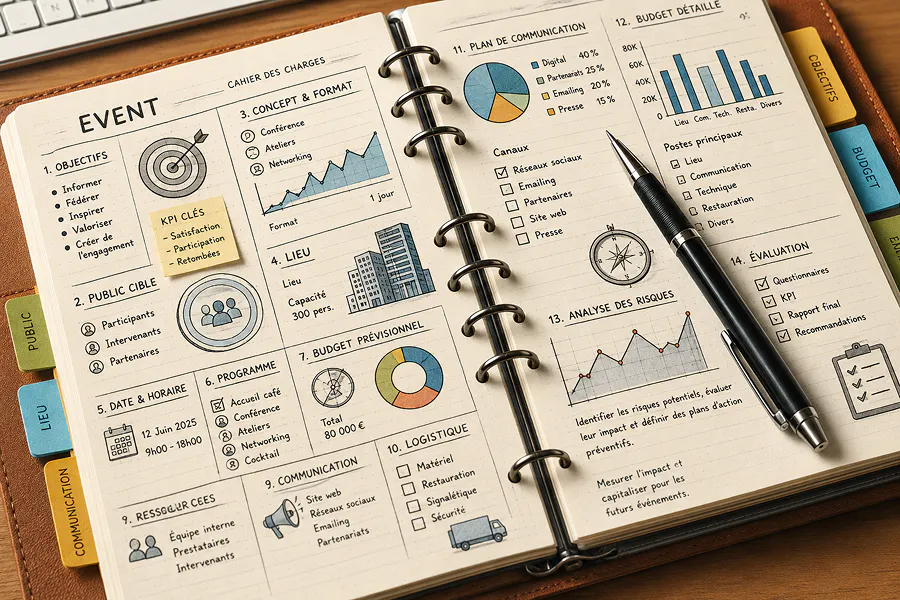
Here we go: you're starting to plan your next corporate event. Attendee list, venue choice, key messages to convey, activities to plan, etc. Where do you start?
The answer comes down to two words: event brief.
You're in the right place to start off on the right foot. Here you'll find everything you need to put together your event brief effectively, without missing a single detail, and with complete peace of mind.
What is an event brief?
An event brief is a very easy-to-understand document that lays out the details of organizing an event.
It can be used just as well by an event agency (to present its proposal to a client) as by the event's sponsor directly (as a tool for organizing the event with the various people to involve within the company).
It's useful for any type of event: trade shows, seminars, team building, incentive trips, openings, project launches, business travel, corporate parties, etc.
Why create a brief for your event?
When organizing an event, nothing can be left to chance. Your guests are watching your every move, and your event brief is there to help you plan everything down to the last detail.
Among the goals of a good event brief, we can highlight the following:
- Clearly describe what's expected from the event and its objectives.
- Carefully plan each step of creating the event. Your brief makes organizing and assigning tasks easier by clarifying the steps, the resources needed, and the deadlines.
- Plan the timing to follow on the day, by detailing how the operations of your event project will unfold.
- Align and coordinate the different people involved (inside and outside the company) in the event. Your event brief lets you sync the expectations of all your participants and partners (clients, teams, vendors) by giving them a clear, detailed picture.
- Reduce errors. By having all the essential information in one centralized document, you avoid misunderstandings and costly mistakes, especially on important logistical details. It also makes it easier to anticipate the unexpected.
- Manage your event budget optimally. By specifying priorities and detailing the elements of your event, it's easier to control your costs and make informed financial decisions
- Streamline communication. Your event brief acts as a shared reference point for teams and partners, ensuring clear, regular communication throughout the project.
What's more, if you're a project manager at an event agency and you're competing for a project, your brief becomes a sales presentation tool for the client. It will let you defend your event scenarios and share your overall vision with the client so they can make an informed choice.
All good reasons to take real care with your next event brief.
"A well-designed event brief is the GPS for your project: it guides you at every step, anticipates the unexpected, and aligns every stakeholder. At Digitevent, we see this tool as the key to a successful event, where every detail is under control to deliver a memorable experience."
Thierry Ottavy, Event Management Expert at Digitevent.
9 steps to write your event brief effectively
Take the time to go through the following nine steps to put together an event brief that's effective, complete, and easy for everyone on your project to understand.
1. Introduce the company and target audience
Start your event brief with a full introduction to your company (or your client's, if you're an agency). Your readers need to understand exactly who your organization is, what it does, and how it does it.
Be sure to detail:
- Your company's history and mission. Briefly summarize your company's history, mission, and vision to set the general context.
- Its core values. Share the organization's core values (innovation, environmental responsibility, quality, etc.) so they can be built into the event design.
- The brand's voice and tone. Give some pointers on the tone your brand uses in its communications. Is it formal, friendly, disruptive?
- The products to highlight, if you're organizing an event related to one or more of the company's products (a launch or presentation).
Now you can move on to your target audience. Take care describing the demographic details of your guests: age, occupation, place of residence, particular interests, etc. But above all, don't hesitate to go into the details of their needs and expectations. What kind of experience is your target audience looking for? Spell out their preferences when it comes to content, format, or communication channels.
The extra Digitevent tip
Include your past event experience in your event brief. Share a few examples of successful events, explaining what worked well. Also mention any challenges or adjustments you'd like to see, to avoid repeating past mistakes and to point toward improvements.
2. Define your event's objectives
Next, tackle the "Why?" section of your event brief. Your readers need to understand why you're running this event, through specific objectives tied to it: boosting awareness, training, networking, bringing employees together, customer loyalty, etc.
Also spell out the main, central message to communicate during your event. For example, you might want to highlight your company's technological innovation, or its closeness to customers.
Finally, include in this section how you plan to measure the success of your event. To do this, define your performance indicators: number of attendees, satisfaction rate, ROI, etc.
The extra Digitevent tip
If your event has several objectives, rank them. The idea: set a priority order for your different objectives, based on which ones bring the most value to your company or the department involved in the event. To do this, reach out to the different departments your event will affect (HR for internal events, sales and marketing for external events, etc.) and gather their needs. This will let you set stronger event priorities, and in turn build an event from a brief that's oriented around ROI.
3. Detail your event's concept and theme
Now it's time to dig into the creative ideas you have for your event. First, simply describe its central theme : is it one of your values? A new product you want to unveil in style? A new achievement to celebrate with your employees?
Then describe the experience you want for your event. What messages and emotions do you want to convey? Specify the atmosphere, staging, style, and creative angle.
The extra Digitevent tip
At this stage of your event brief, think storytelling. The most captivating events are the ones that inspire attendees, to strengthen their engagement. So play on strong themes (like "the pursuit of excellence" or "looking ahead to the future"), or simply on a problem facing your audience that your event will help solve. Picture your attendees as the main characters in a great story you need to tell over the course of the event.
4. Set your estimated budget
Every good brief includes a projected event budget. So lay out your financial resources, with an overall budget envelope, along with a breakdown into subcategories: venue, catering, decoration, communications, etc.
For an effective estimated budget, list all the essential line items (venue rental, catering, technical equipment, entertainment, communications, transport, accommodation, etc.). Then rank each line item by priority based on your event objectives. This ranking lets you adjust as needed, and keep in mind the items likely to fluctuate, like catering, if your number of attendees changes.
The extra Digitevent tip
Don't forget to set an emergency budget, an amount set aside for the unexpected. It's generally recommended to devote 10 to 15% of your budget to these event emergencies (which aren't rare!).
5. Choose your event's venue and dates
At this stage, it's time to draw up a set of specifications for the venue where the event will take place.
In it, be sure to describe:
- The capacity of the venue you're looking for, based on the expected number of guests. If it's a remote event, indicate the capacity needed from your video conferencing software.
- The event's accessibility, in terms of location.
- The types of equipment needed: is it a seated event? A sit-down meal? Standing?
Then specify the date and times your event will take place, taking into account your target audience's availability and any competing events.
The extra Digitevent tip
With corporate social responsibility (CSR) more than ever at the heart of companies' concerns, don't forget to specify at this stage whether you want your event to take place at a CSR-certified venue, or as close as possible to your audience to limit their travel (and therefore your event's carbon footprint).
6. Build your event's program and schedule
What will your guests do during your event? That's what this part of your event brief needs to answer. Make a list of the activities you'll offer them and, if possible, plan out the general schedule (sessions, breaks, entertainment).
Also detail here the speakers to include in the program. If possible, indicate their speaking times and the type of activities they'll be handling (talks, workshops, panel discussions).
The extra Digitevent tip
If you don't yet have a clear idea for how your event should unfold, start from a common thread that will guide it. This could be the presentation of your new product, for example, or networking between attendees. Then organize your various activity ideas around that thread. To be impactful and memorable, your event should be structured around key moments, starting with a captivating opening and ending on an inspiring close.
7. Describe your logistics and technical needs
This is the time to get into the technical details of your event brief. Take the time to list them one by one, to keep your event organization tight.
Be sure to include in your event brief:
- The equipment you'll need. Draw up a list of the equipment required, in terms of sound, lighting, and projection.
- The infrastructure you need. Identify specific requirements, such as a solid internet connection, exhibition spaces, accessibility for people with reduced mobility, waste-sorting facilities for a zero-waste event, or the use of sustainable materials for your event furniture.
The extra Digitevent tip
In this part of your brief, plan out the security measures to put in place for your event.
- For an in-person event, think about evacuation plans, event monitoring, access control, and crowd management.
- For a remote event, state your expectations around personal data management and GDPR.
And to secure entry to your event, what better than an event management platform like Digitevent? Our software offers simplified guest check-in, all accessible on mobile and tablet, much to the delight of your reception staff.
8. Define your communication and promotion strategy
It's time to define the communication plan around your event, which will help boost its visibility. Choose the channels that will effectively reach your audience, based on where they get their information: social media, email, press, etc.
Also plan out a promotional calendar, detailing your action plan before, during, and after the event to maximize its visibility.
Finally, also specify how you plan to manage registrations and invitations. Even at this stage of the event brief, you can choose an online registration platform. Also plan for reminders and confirmations for registrants.
The extra Digitevent tip
With Digitevent, easily manage your guest list on an intuitive, user-friendly platform. Automate your reminders to cut down on no-shows and engage your attendees ahead of the event.
9. Plan KPIs for post-event evaluation
The last step of your event brief, and not the least important: preparing how you'll measure your event's performance. This should be based on the event objectives you set out in step two.
Be sure to include:
- Satisfaction surveys, to gather attendee feedback after the event.
- Performance indicators to track to measure the event's impact and success: number of attendees, engagement, feedback...
To do this, don't hesitate to rely on an event management platform that gives you access to complete dashboards. There, you'll be able to view all the KPIs tied to your event, such as registrations, peak attendance times, guest engagement, or your participation rate.
The extra Digitevent tip
Is CSR central to your communications? Build it into your post-event evaluation. For example, state in your brief that you want to measure your event's environmental impact using a carbon footprint calculator.
Extra tips for a successful event brief
Don't leave without reading these key tips, which will help you put together a well-honed event brief, and in turn organize a quality event.
Involve all stakeholders before creating the brief
Alone, you go faster. Together, you go further. Gather input from all your event's stakeholders. Talk with some of your clients, suppliers, and partners to fold their expectations into your event brief. This builds buy-in and reduces adjustments later on.
Also clarify everyone's responsibilities in organizing the event. State who's responsible for each aspect. This cuts down on confusion and encourages accountability.
Co-build your event brief between sponsor and organizer
Best practice: create a collaborative event brief, where each stakeholder can include their needs and expectations.
- On one hand, the event sponsor (the client for an agency, or the internal client for an event organizer working directly for the advertiser) includes the criteria and requirements expected for the event, along with their specific concerns.
- On the other hand, the organizer (the event agency or the internal organizer) includes the information needed for the event project to run smoothly, along with their expertise in event communication.
This way, your event brief is truly complete.
Check that your event brief covers the 5W method
The 5W method is useful for making sure your event brief answers all the key questions needed to organize it.
Use it as a checklist to confirm you've included the following in your brief:
- The "What", meaning your event's format
- The "Why", meaning your event's objectives, and the issues it needs to address
- The "Where", meaning your event's location
- The "When", meaning your event's dates and times
- The "Who", meaning your event's target audience
Use a simple format
The simpler your event brief is, the easier it will be for all your stakeholders to understand, and the more effective it will be. So stick to the essentials. Be direct in your descriptions. Use simple sentences and limit technical jargon to avoid misunderstandings.
Also, organize your brief into sections. Structure your document into clear headings to make it easier to read, each one matching the 9 steps described in this article.
Finally, simplify the language you use. Write in an accessible style so that everyone involved clearly understands your expectations and ideas.
Use visuals to make your brief easier to understand
What better way to make a document easier to understand than visuals? Include some in your event brief: they'll help your readers clearly grasp what you expect.
Be sure to include:
- Moodboards and reference images (photos or sketches) to illustrate the desired theme and visual atmosphere
- Tables for listing your budget or logistics information
- Gantt charts to illustrate deadlines
- Org charts to introduce your team members
And don't forget that managing an event means thinking through a multitude of details, each as important as the next in the overall experience your attendees have. So use a complete event management platform that simplifies your life from start to finish.
Discover Digitevent, the event software that lets you expertly manage all your corporate events, from invitations to attendee engagement on the day.