All customer challenges now play out in the field of recruitment. You need to attract, build consideration, convert, and finally retain, in that order. Beyond the crucial question of recruitment, namely how to identify the right candidate, here are the challenges facing employers today:
- How to connect the company and candidates
- How to build an attractive employer brand
- How to succeed at onboarding
- Continuous training and information flow
A well-suited answer to all these questions ensures a candidate journey beyond reproach and strengthens the employer brand. The good news is that events can help provide answers to each of these challenges:
How do events connect the company and candidates?
As mentioned: a candidate should be seen as having the same expectations of a company as a customer does, the first of these being the need for values alignment. Your goal is therefore to communicate your company values to your future employees.
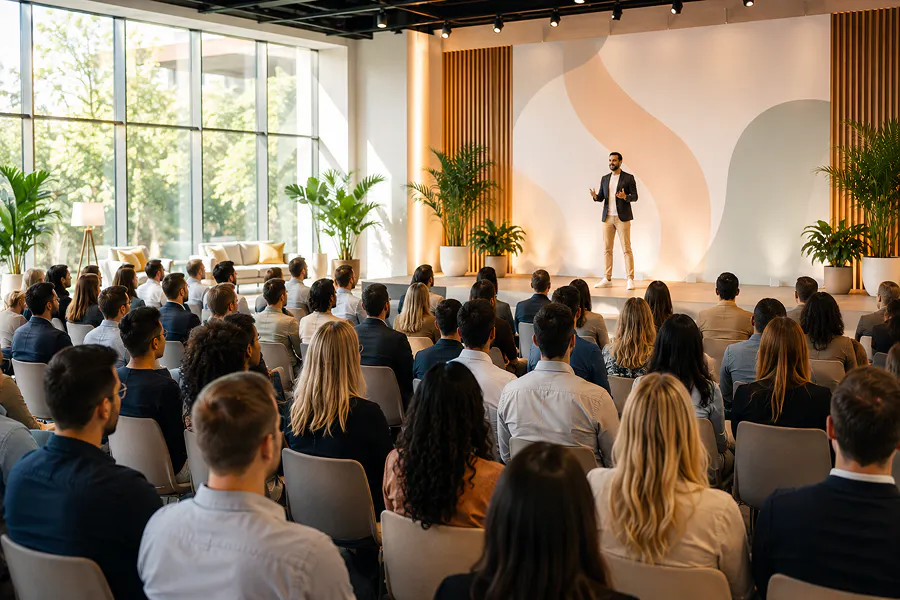
The event (whether physical, virtual, or hybrid, with nuances for each) allows you to fully embrace this approach. It represents you, it's your chance to convey your values and culture to your candidates, so that only those who share them want to move forward with you.
An event such as a product launch, a public evening, or a conference will inevitably attract qualified potential candidates who are interested in your topic, and therefore indirectly in your company (the work here is to make sure your company becomes the reference on that topic). Holding one or more team-building events each year, or promoting regular after-work gatherings, can also attract your future talent.

It's up to you to create the exceptional event that will (and this is the whole point) elevate your event to another status: that of an experience.
An experience where every detail is carefully thought out from start to finish will undeniably position your brand in people's minds as one with an eye for detail, professional and attentive.
The role of events in building an attractive employer brand
To convince a candidate, every touchpoint now needs to be polished and refined, because the candidate becomes an ambassador.
The balance of power between a company and a candidate is shifting, largely due to changes in the job market. Brands therefore need to redouble their efforts to build a strong employer brand and recruit the best talent.
To do this, a brand must constantly build its visibility so that candidates come to it naturally.
What better opportunity to do this than creating your own career days (virtual or in-person) to meet your target audience, or why not invite the schools you're targeting to some of your corporate evenings to spark meetings?
Whichever option you choose, the event will always boost your brand image and visibility, even when that isn't always the primary goal. Some brands understand this well and use every event as an opportunity to turn it into a unique experience that will earn them visibility and a high share rate on social media. This is notably the case for Apple.
Succeeding at onboarding with digital and events
To meet recent graduates, the tradition is generally to attend school career fairs, trade shows, and other job fairs.
However, this type of format is now limited (and not only because of Covid), since candidates want to know a company's values as much as their future work environment (as shown by the popularity of sites like Glassdoor). These events therefore remain necessary but not sufficient. Listen to your teams' ideas and welcome feedback on your company's onboarding strategy.
This is exactly where digital comes in: it helps simplify the encounter with candidates by making the application process smoother. Footlocker, for example, streamlined its recruitment process as much as possible with a mobile app to improve its candidate experience.
Beyond the reasons mentioned above, this highly digital approach implicitly signals to your future hires that you understand the codes of your time, and this is also a differentiating factor
Finally, live or recorded video interviews meet the need for authentic contact (which builds confidence), for both candidate and employer alike: the candidate can picture themselves in the office and on the team they'll join, while the employer gets a glimpse of the soft skills (eloquence, presentation, punctuality, etc.) of their future employee.
Events matter for passion-driven industries
In high-pressure sectors, particularly with developers, the hunt for talent is tricky. Relations between developers and overly pushy HR teams can sometimes be tense. These profiles are, of course, in high demand, and can receive 10 to 15 contact requests a day.
The candidate experience is improved through an in-person meeting at an event, which helps win candidates over and move past this aversion to HR and aggressive headhunting, creating a healthier climate.
To recruit this type of candidate, it's better to meet them at technical events rather than at traditional finance-industry job fairs, as AXA's Employer Brand Manager explains in an interview.
It can't be said enough: the boom in professional gatherings, and networking more broadly, stems from a much wider social demand. Remember that Meetup predates Facebook by a few years.
Internal events, for training and information sharing
More and more, HR departments are now supported by “talent managers”.
These people are responsible for continuous training in companies where employees need to have a roughly similar skill level that keeps improving over time.
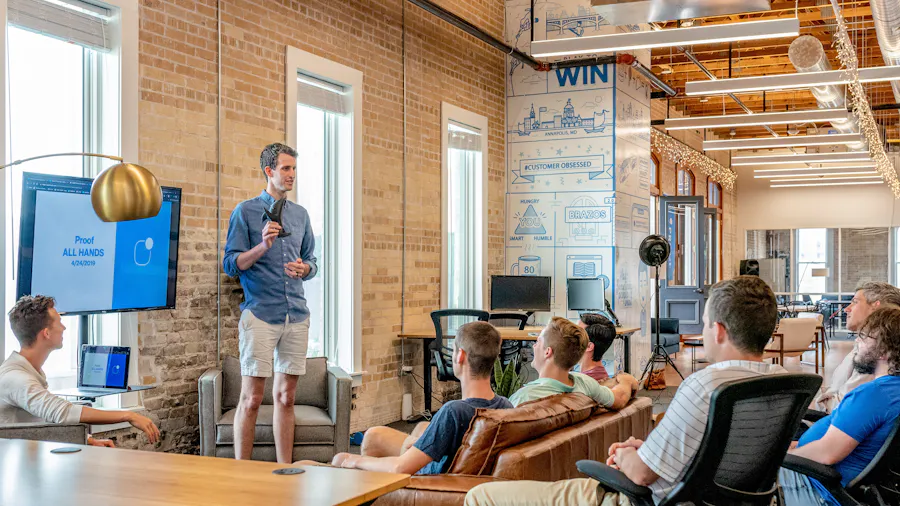
Consulting firms are typically where you find this kind of profile. The internal event is then the ideal way to bring these people together around training sessions and seminars to help them all progress together and ensure consistency among employees.
As for information cascading, it's often a priority, even critical, in very large organizations, helping to align perspectives and communicate well within a company that's often full of hierarchical layers (this type is often represented by large public-sector administrations or private-sector leaders).
This information cascade should take place at an event attended by all managers, whether in person or remote. These major gatherings are usually rare occasions: realigning the group's values or a new vision, a change of director and therefore a new strategic direction, etc.
Either way, the event undoubtedly adds real value in avoiding misunderstandings and information gaps during a company's key moments.
In conclusion
These approaches reflect the paradigm shift in the recruitment sector. Digitalization and the use of unconventional events put the candidate at the center of the game, while still having a brand strong enough to draw the right profiles toward it. Not everything is overturned or needs rebuilding, but the more processes become digital and complex, the more necessary face-to-face meetings become.