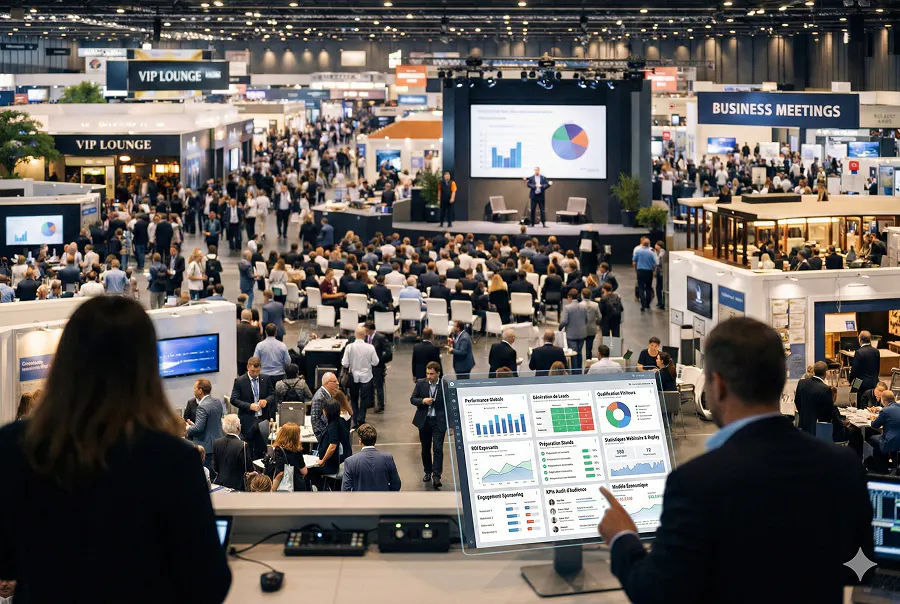
In France, according to UNIMEV, company investment in events is increasing (source: UNIMEV, reported by CB News). Good news? Yes. But it also means more competition, higher expectations, and more pressure on the profitability of your trade show, whether B2B or consumer-facing.
Problem: many trade shows are full, well-liked, but not really profitable.
In our recent webinar, we invited Expose and Make a Move to show concretely how to move from an intuition-led trade show to a data-driven business, and optimize the organization of your event strategically.
Request the replay to discover the full method, or read this article to extract the essential best practices and structure your trade show for profitability.
A full trade show isn't necessarily a profitable one!
You may have already experienced this: satisfying attendance, exhibitors who are broadly happy, a great image on social media, and yet a thin margin.
In practice, the warning signs are often the same:
- Exhibitor pricing that's hard to justify
- Sponsorship that's hard to sell
- Few indicators to demonstrate exhibitor ROI
- Partners becoming more demanding from one edition to the next, in an increasingly competitive market
If your trade show seems to be working, it isn't creating enough measurable value. The result? It's hard to convince new exhibitors, build loyalty, and raise prices.
For a long time, organizing a trade show relied on a simple model: selling square meters. But today, that model belongs to the past.
Today, exhibitors no longer buy just a booth. They buy useful visibility, qualified leads, business meetings, and access to a precisely defined target audience.
In other words: they invest to get a measurable result.
A trade show or consumer event can no longer be run like a simple fair or exhibition. It's structured as a genuine event business model.
"For a long time, we sold square meters. Today, exhibitors no longer buy a booth: they invest to reach the right audience, generate concrete opportunities, and get a measurable return on their participation. The only equation that matters is simple: engaged visitors create value for exhibitors, and that value becomes the engine of the organizer's revenue. If one link is missing, the business model weakens.", Jonathan Astruc, Co-founder of Digitevent
The prerequisites for successfully organizing a profitable trade show
Organizing a profitable trade show doesn't start with choosing the venue or laying out the booths. It starts with a strategic question: who are you really creating value for?
Know your audience inside out: visitors and exhibitors
Wondering why some trade shows raise their prices without pushback, while others struggle to fill their space? The answer comes down to one word: audience.
To successfully organize your trade show, you need to know precisely:
- Visitor profiles (role, industry, decision-making level)
- Their purchasing project
- The business objectives of exhibitors
- Their budget capacity and their role in the decision-making process
When your target audience is qualified and engaged, exhibitors generate relevant leads, business meetings are productive, and post-event sales increase. The result? You can justify your pricing, increasing perceived value and building a sustainable model for your trade show's success.
And remember that a trade show is first and foremost a business ecosystem that can evolve from one edition to the next: new industries, new decision-makers, new needs. Without regularly updating your audience data, you're steering by intuition instead of targeting your audience effectively.
Identity and storytelling: the underrated levers
We often talk about location, capacity, catering, scheduling, or event logistics management. But rarely about identity. Yet a successful trade show also relies on a coherent marketing strategy and a differentiating value proposition.
Ask yourself these questions:
- What is your mission in your industry?
- What specific problem are you addressing?
- Why this trade show rather than another one, in today's competitive landscape?
Clearly defining your identity helps you target the right audience, attract new, aligned exhibitors, and structure consistent communication.
To play up your storytelling, don't hesitate to use levers that involve exhibitors and visitors ahead of time, to create a sense of belonging, such as pre-event meetups or webinars, or a dedicated activity before the show's official opening.
Using data to run your event and increase revenue
Want to organize a trade show that's profitable? Then you need to move beyond steering by intuition.
Without data, there's no way to prove exhibitor ROI, justify your pricing, or optimize your business model. You're flying blind.
A modern trade show is run like a business, with precise indicators and decisions based on facts.
The 5 factors that actually create ROI for exhibitors
Exhibitors don't invest just to be present. They invest to generate results.
Here's what concretely creates value for them:
- Useful, targeted visibility with the right audience
- Speaking opportunities with strong editorial value, reusable after the event
- Quality of leads collected, not their volume
- Qualified business meetings
- Interactions with the right audience (decision-makers, influencers)
The KPIs that really matter
Here are the key metrics for steering your trade show organization:
- Audience KPIs: visitor profiles, % core target audience, % decision-makers, breakdown by job function and/or industry
- Engagement and content KPIs : digital interest in the program, participation rate in conferences and/or workshops, feedback
- Business and interaction KPIs : leads collected (scanning of badges), qualification, scoring, notes, meetings held, sales analysis, exhibitor ROI
The trick to use? Ask at the right time. Satisfaction surveys are often sent too late. Send them right away at the end of the event, or during a social gathering you organize with your exhibitors a few days after your event. This way, you gather more qualitative, more actionable feedback, to concretely improve the next edition.
The method for evolving your trade show without losing your identity
A trade show is a fragile ecosystem. Changing too much at once can create organizational risks and a confusing experience for visitors, as well as prevent exhibitors from properly preparing for the show. Here's the method for structuring your trade show more intelligently without completely transforming it overnight.
Step 1: put the fundamentals in place
Before adding tools or options, you need to clarify what you're selling. A profitable trade show relies on a clear offer, simple to understand for both your exhibitors and your audience.
Focus first on three pillars:
- Booth sales, by setting up a coherent booth layout and guaranteeing a minimum qualified audience
- Simple ticketing, by communicating about audience quality and visitor typology
- Sponsorship, through clear materials, simple offers, and understandable packages
These fundamentals secure the organization of your trade show.
Step 2: deploy tools with high ROI impact
Once the foundation is solid, you can activate measurable levers, such as:
- Lead scanning and exhibitor reporting. The technology you use should let you score a lead (hot / warm / cold), add notes to each profile, and sync leads to a CRM. This tool should be more than a file to process later, but a real tool for immediate sales management.
- The exhibitor marketplace, a marketplace that lets exhibitors add extra services to their booth. It allows the organizer to generate additional revenue through a single point of purchase, and simplifies the exhibitor's journey. It also helps exhibitors prepare to communicate effectively. It's a good lever for organizers to increase the average exhibitor spend.
Step 3: put structuring business levers in place
For trade shows focused on lead generation, certain features make the difference.
This is particularly true for qualified business meetings. The idea: organize a schedule allowing 5 to 10 qualified meetings per day for each exhibitor. This lever requires some upfront preparation, with the deployment of a matchmaking platform, early communication, and dedicated activities. But the impact on exhibitor ROI is major.
You can also think about business spaces dedicated to targeted networking, also known as VIP areas or lounges. These spaces should be reserved for the right profiles, namely decision-makers. This requires a detailed understanding of your visitor base.
To increase the perceived value of your trade show, you can for example:
- Set up an engaging activity in a dedicated area of the show
- Organize a dinner after the event to bring together carefully selected profiles
Finally, sponsored conferences and workshops are particularly interesting. You allow your exhibitors to take the floor, to be showcased as experts, but with strict content moderation, to maintain a well-honed editorial line that isn't too commercial.
Move from an intuition-led trade show to a data-driven business
Want to organize a truly profitable trade show, with clear indicators and a structured business model?
In the replay of our webinar with Expose and Make a Move, Yann Azran breaks down the concrete levers used to evolve the Congrès du VTC, which held its third edition in 2026 with 3,000 participants. Positioning, offer, data, exhibitor ROI: it's all explained, backed by figures.
If you want to turn the organization of your trade show into a sustainable growth engine, request the replay by contacting our team and walk away with an actionable method.